
Anyone who has spent real time learning a second language eventually asks the same question: what can this actually turn into? For a growing number of people, the answer is teaching. Schools across the country are short on educators who can teach in more than one language, and that gap is opening up a career path that didn't look nearly this open a decade ago.
Why Schools Need Language Teachers More Than Ever
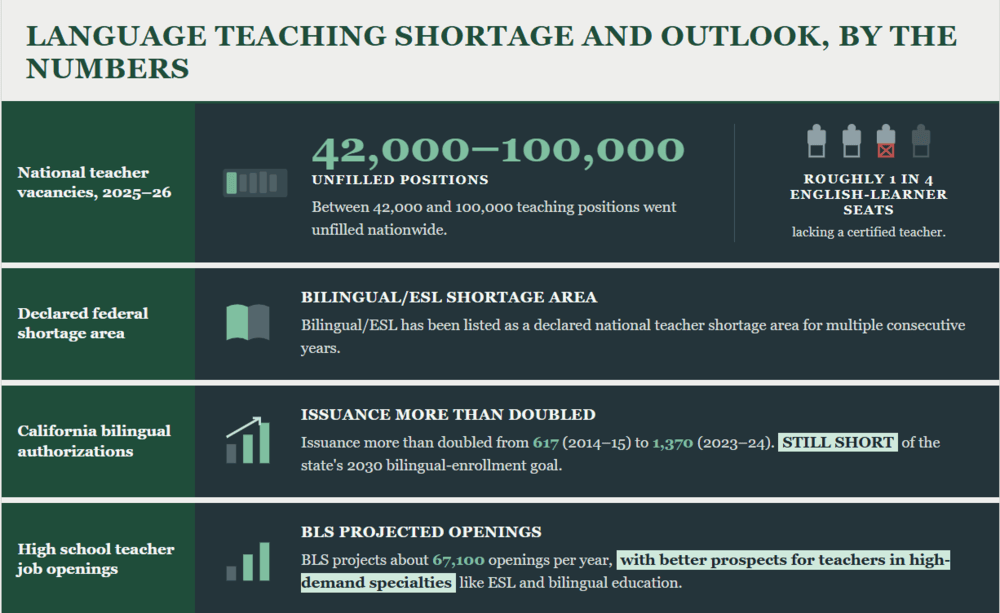
The shortage is not a small one. The United States entered the 2025-26 school year with somewhere between 42,000 and 100,000 vacant teaching positions, and bilingual and ESL classrooms absorbed the worst of it, leaving roughly one in four English-learner seats without a certified teacher in front of them. The U.S. Department of Education has listed Bilingual/English as a Second Language among its declared national teacher shortage areas for several years running, alongside fields like special education and computer science.
States are trying to close the gap, but slowly. California, for example, more than doubled the number of bilingual teaching authorizations it issued annually, from 617 in 2014-15 to a record 1,370 in 2023-24, yet the state still falls well short of its own goal of enrolling half of all K-12 students in bilingual programs by 2030. That kind of mismatch between demand and supply is showing up in states well beyond California.
The Path From Language Learner to Certified Teacher
Language ability alone does not put someone in front of a classroom. Teaching still requires formal certification, and the route to get there depends heavily on where someone is starting from. Someone earning a bachelor's degree in education or foreign language studies will typically complete their certification requirements as part of that degree. Someone coming from a different background, a business degree, a psychology degree, or years spent simply learning a language as a hobby, usually needs a separate path into the classroom.
That's where licensure programs for teachers come in, many states run alternative certification tracks built specifically for career changers, letting someone with a non-education degree complete coursework and supervised teaching hours without starting a whole new bachelor's degree from scratch. Other routes worth knowing about include TESOL certificate programs, which focus specifically on teaching English to speakers of other languages, and master's programs in applied linguistics or bilingual education for people who want a deeper specialization before entering a classroom.
Where Bilingual Educators Are Needed Most
Not every teaching role needs a second language, but the ones that do tend to have better job prospects. The Bureau of Labor Statistics projects roughly 67,100 high school teaching openings per year through the early 2030s, with employment growth for the profession overall staying fairly flat. Teachers who specialize in high-demand subjects, ESL and bilingual education among them, consistently have an easier time finding work than generalists.
Dual-language immersion programs, in particular, have expanded fast enough that staffing hasn't kept up. These programs teach core subjects like math and science in two languages simultaneously, and they need teachers who are fluent enough to instruct in both, not just conversational.
Beyond the Classroom: Related Career Paths
Teaching isn't the only place language skills translate into a career, and it's worth keeping the other options in view even while training toward certification. Interpreters and translators, international business roles, and hospitality or tourism management all draw heavily on the same underlying skill set. Someone who starts down the path toward a teaching license and later decides the classroom isn't the right fit hasn't wasted the effort. The language proficiency, cultural fluency, and communication skills built along the way carry over directly into those other fields.
People also ask
Do you need a language degree to become a bilingual teacher?
Not necessarily. A degree in education or a foreign language is the most direct route, but many teachers reach fluency through immersion, family background, or independent study and then complete a certification program built for their situation.
What's the fastest way to become a certified teacher if I already have a different bachelor's degree?
Alternative or accelerated licensure programs are usually the quickest option, since they focus on the coursework and supervised teaching hours needed for certification rather than requiring a second full degree.
Are bilingual teachers paid more than other teachers?
Pay varies by district and state, but many districts offer stipends or bonuses specifically for bilingual or dual-certified teachers, on top of the standard salary scale, because those positions are harder to fill.
Language Teaching Shortage and Outlook, by the Numbers
Closing Thought
A second language opens more doors than most people realize when they first start learning one. Teaching happens to be one of the doors with real demand behind it right now, and for anyone weighing whether to go back for a full degree or take a faster path in, licensure programs for teachers exist precisely to make that decision easier.